SAPTARI 2030 · 2040 · 2050
A citizens' campaign envisioning the Saptari of 2030, 2040 and 2050 — partnering with individuals and organisations, at home and in the diaspora, to create a positive, conducive environment for the overall development of the district.
The milestones below are a draft framework for discussion with partners and citizens; they will be refined through the campaign's Poll pillar.
An active, organised civic society; a functioning endowment fund seeding local enterprises; credible baseline data; and the first flagship projects in energy, business promotion and conservation under way.
A hub of the eastern Madhesh: reliable local energy production, locally-owned businesses and incubated startups, restored wetlands and Chure watersheds, and young people who see their future in Saptari.
A prosperous, resilient and self-confident Saptari — the "Heart of Mithila" — whose institutions, economy and environment sustain themselves, and whose model is studied by other districts.
All Saptari Next activity is organised under four pillars.
Concrete, time-bound interventions with defined outcomes — designed with partners, resourced through the campaign's networks and endowment fund, handed over to local owners when complete.
Continuing streams of work that run across years — civic education, entrepreneurship support, environmental stewardship — building lasting local capacity.
The listening pillar. Surveys, consultations and opinion research keep the campaign accountable to the district, not to any single interest.
The knowledge pillar. Documenting the district and publishing manuals, reports and studies so every partner works from a shared, credible base of facts.
Organising citizens to participate in public life, local planning and accountability.
Promoting local generation and productive use of energy — building on Saptari's early lead in solar irrigation.
Supporting local enterprises, market linkages and the district's trading strengths.
Building an endowment fund whose returns seed and incubate local ventures and community initiatives.
Protecting the district's rivers, wetlands, forests and the Koshi Tappu ecosystem — Nepal's first Ramsar site.
In partnership with Maithili Wikimedians, Saptari Next organised an exhibition of 101 photographs by Anant Arjun Dev on the theme "Birds of Madhesh" at ChaiCharcha, Rajbiraj.
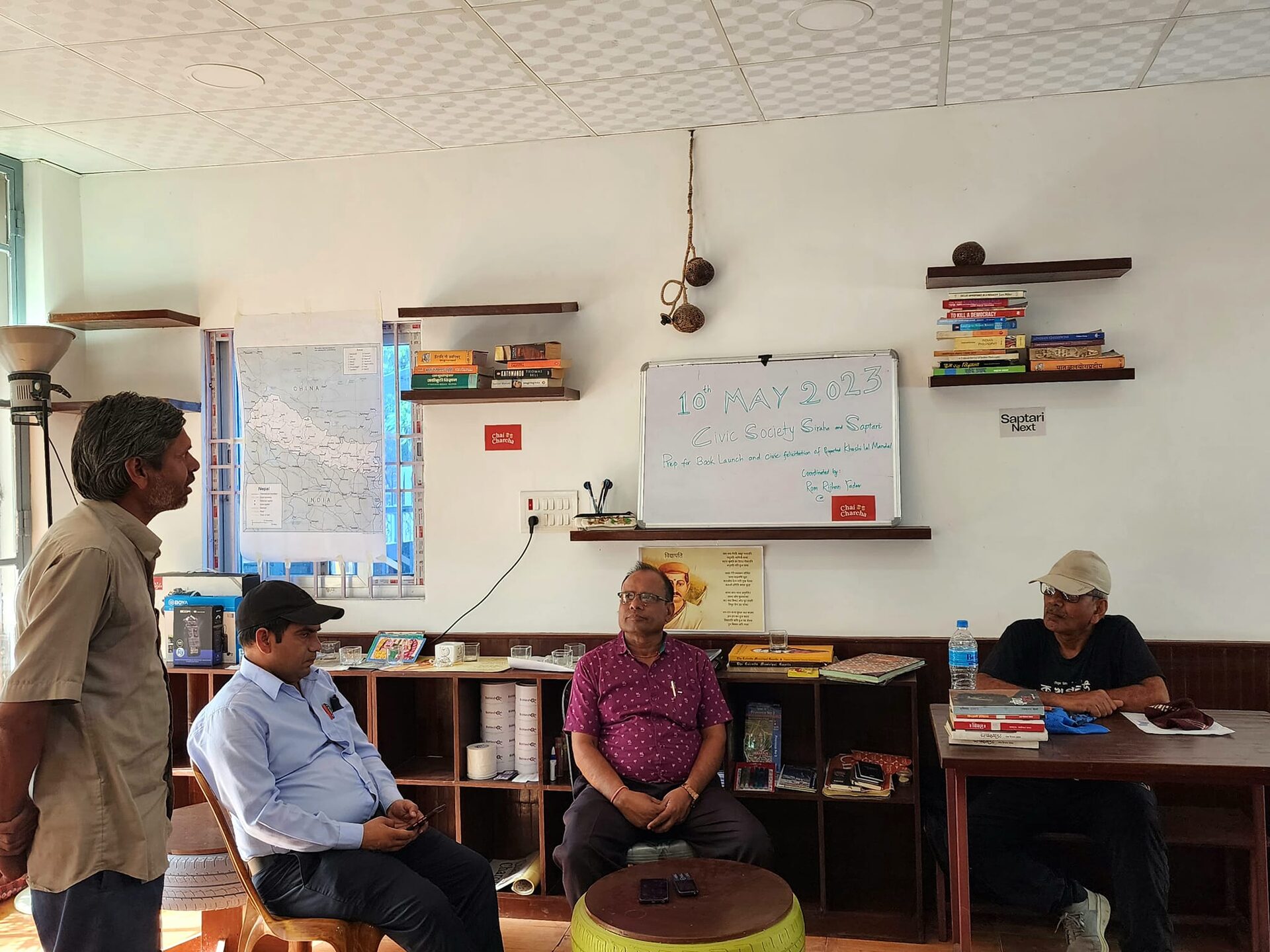
From chai-charcha conversations to leadership conferences with JCI and MWUG, the campaign convenes citizens across the district to imagine Saptari's future together.